

Table of Contents
The Conversion from Fahrenheit to Celsius: Understanding the Science Behind It
When it comes to measuring temperature, two of the most commonly used scales are Fahrenheit and Celsius. While Fahrenheit is predominantly used in the United States, Celsius is the standard unit of temperature measurement in most other parts of the world. Understanding how to convert temperatures from Fahrenheit to Celsius is essential for anyone working in a scientific or technical field, as well as for everyday use.
What is Fahrenheit and Celsius?
Fahrenheit and Celsius are two different temperature scales used to measure temperature. The Fahrenheit scale was developed by Daniel Gabriel Fahrenheit in the early 18th century and is based on a scale where water freezes at 32 degrees and boils at 212 degrees. On the other hand, the Celsius scale, also known as the centigrade scale, was developed by Anders Celsius in the mid-18th century and is based on a scale where water freezes at 0 degrees and boils at 100 degrees.
The Formula for Converting Fahrenheit to Celsius
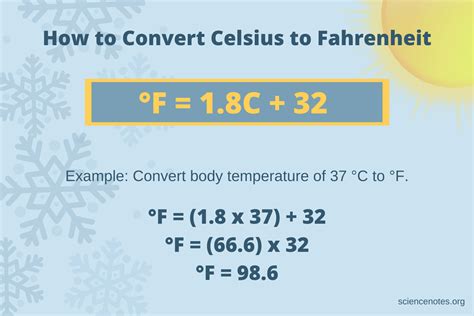
The formula for converting Fahrenheit to Celsius is as follows:
Celsius = (Fahrenheit – 32) x 5/9
For example, if you have a temperature of 68 degrees Fahrenheit and you want to convert it to Celsius, you would use the formula as follows:
- Celsius = (68 – 32) x 5/9
- Celsius = 36 x 5/9
- Celsius = 20
Therefore, 68 degrees Fahrenheit is equivalent to 20 degrees Celsius.
Why is it Important to Understand Fahrenheit to Celsius Conversion?
Understanding how to convert temperatures from Fahrenheit to Celsius is important for a variety of reasons. For one, it allows for easier communication and comparison of temperature readings between different regions that use different scales. Additionally, many scientific experiments and calculations require temperature measurements to be in Celsius, so being able to convert between the two scales accurately is crucial.
Real-World Applications
One real-world example of the importance of understanding Fahrenheit to Celsius conversion is in weather forecasting. Meteorologists around the world use Celsius as the standard unit of temperature measurement, so being able to convert temperatures from Fahrenheit to Celsius is essential for accurate weather predictions.
Another example is in the field of medicine, where body temperature is typically measured in Celsius. Healthcare professionals need to be able to convert temperatures from Fahrenheit to Celsius to accurately monitor and treat patients.
Conclusion
Understanding how to convert temperatures from Fahrenheit to Celsius is a valuable skill that has practical applications in various fields. By knowing the formula and being able to perForm the conversion accurately, you can communicate effectively, make informed decisions, and contribute to scientific research and analysis. Whether you are a student, a scientist, or simply someone interested in learning more about temperature measurement, mastering the conversion from Fahrenheit to Celsius is a fundamental skill that can benefit you in many ways.

