

-
Table of Contents

The 6 Signs of Chemical Change
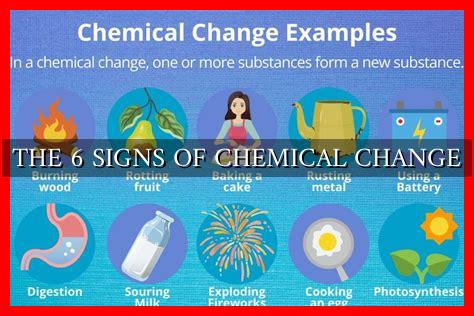
Chemical changes, also known as chemical reactions, occur when substances combine to form new substances with different properties. These changes are crucial in various fields, including chemistry, biology, and everyday life. Understanding the signs of chemical change can help us identify and analyze these reactions. In this article, we will explore the six key signs of chemical change.
1. Color Change
One of the most noticeable signs of a chemical change is a color change. When substances react chemically, they often produce new compounds with different colors than the original substances. For example, when iron rusts, it changes from a shiny silver color to a reddish-brown color. Similarly, when copper reacts with oxygen in the air, it forms a greenish-blue compound called copper oxide.
2. Gas Production
Another common sign of chemical change is the production of gas. When certain substances react, they release gases as byproducts. This can be observed in reactions such as the combination of baking soda and vinegar, which produces carbon dioxide gas. The formation of bubbles or fizzing is a clear indication of gas production in a chemical reaction.
3. Temperature Change
Chemical reactions often involve the absorption or release of energy in the form of heat. As a result, temperature changes can be a sign of a chemical change taking place. For example, when magnesium metal reacts with hydrochloric acid, the reaction is exothermic, releasing heat and causing the temperature to increase. In contrast, some reactions are endothermic, absorbing heat and causing the temperature to decrease.
4. Precipitate Formation
Precipitate formation is another sign of chemical change that occurs when two solutions react to form an insoluble solid. This solid, known as a precipitate, separates from the solution and settles at the bottom of the container. An example of this is the reaction between silver nitrate and sodium chloride, which forms a white precipitate of silver chloride.
5. Odor Change
Changes in odor can also indicate a chemical change. When substances react chemically, they often produce new compounds with distinct odors. For instance, the reaction between hydrogen sulfide gas and iron metal produces a foul-smelling gas called hydrogen sulfide. Similarly, the decomposition of organic matter produces the characteristic smell of rotting food.
6. Light Emission
Some chemical reactions produce light as a byproduct, known as chemiluminescence. This phenomenon can be observed in reactions such as the oxidation of luminol, which emits a blue glow. Light emission is a unique sign of chemical change that is often used in forensic science to detect bloodstains at crime scenes.
Conclusion
Understanding the signs of chemical change is essential for identifying and analyzing chemical reactions in various contexts. By recognizing color changes, gas production, temperature changes, precipitate formation, odor changes, and light emission, we can gain valuable insights into the nature of chemical reactions. These signs not only help us understand the underlying processes but also have practical applications in fields such as chemistry, biology, and forensic science.
For further reading on chemical changes, you can explore this article.
