-
Table of Contents
Solutions for Class 12 Chemistry Chapter 2
Chemistry is a fascinating subject that deals with the composition, structure, properties, and changes of matter. Class 12 Chemistry Chapter 2 focuses on solutions, which are homogeneous mixtures of two or more substances. Understanding the concepts and principles of solutions is crucial for students to excel in their chemistry studies. In this article, we will explore some key solutions for Class 12 Chemistry Chapter 2 and provide valuable insights to help students grasp the topic effectively.
Types of Solutions
There are three main types of solutions based on the state of solute and solvent:
- Gas in Gas: Examples include air and hydrogen in nitrogen.
- Gas in Liquid: Examples include carbon dioxide in water and oxygen in water.
- Liquid in Liquid: Examples include alcohol in water and benzene in toluene.
Factors Affecting Solubility
The solubility of a solute in a solvent is influenced by several factors:
- Nature of Solute and Solvent: Like dissolves like. Polar solutes dissolve in polar solvents, and non-polar solutes dissolve in non-polar solvents.
- Temperature: Generally, solubility increases with temperature for solid solutes in liquid solvents, but decreases with temperature for gas solutes in liquid solvents.
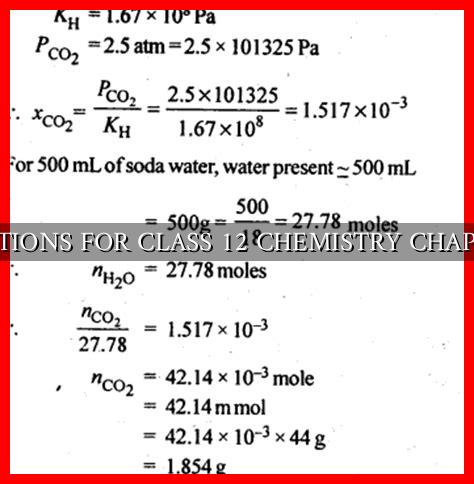
- Pressure: Pressure has a significant impact on the solubility of gases in liquids.

. Henry’s Law describes this relationship.
Colligative Properties
Colligative properties depend on the number of solute particles in a solution, regardless of their nature. These properties include:
- Boiling Point Elevation: Adding a non-volatile solute to a solvent increases its boiling point.
- Freezing Point Depression: Adding a solute to a solvent lowers its freezing point.
- Osmotic Pressure: The pressure required to stop osmosis across a semipermeable membrane.
Preparation of Solutions
There are various methods for preparing solutions, such as:
- Mass by Mass Percentage: Calculated as (mass of solute / mass of solution) x 100%.
- Volume by Volume Percentage: Calculated as (volume of solute / volume of solution) x 100%.
- Molarity: Defined as the number of moles of solute per liter of solution.
Applications of Solutions
Solutions play a crucial role in various industries and everyday life. Some common applications include:
- Medical Field: Intravenous solutions for hydration and drug delivery.
- Food Industry: Flavoring agents and preservatives in food products.
- Chemical Industry: Solvents for chemical reactions and processes.
Conclusion
Class 12 Chemistry Chapter 2 on solutions is a fundamental topic that lays the groundwork for understanding more complex concepts in chemistry. By mastering the types of solutions, factors affecting solubility, colligative properties, preparation methods, and applications of solutions, students can enhance their knowledge and excel in their academic pursuits. It is essential to practice solving numerical problems and conducting experiments to reinforce the theoretical concepts discussed in this chapter. With a solid understanding of solutions, students can navigate through the intricate world of chemistry with confidence and proficiency.