-
Table of Contents
Compare and Contrast Mitosis and Meiosis
Cell division is a fundamental process in all living organisms, essential for growth, development, and reproduction. Two main types of cell division are mitosis and meiosis, each serving distinct purposes in the life cycle of an organism. In this article, we will compare and contrast mitosis and meiosis, highlighting their similarities and differences.
Mitosis
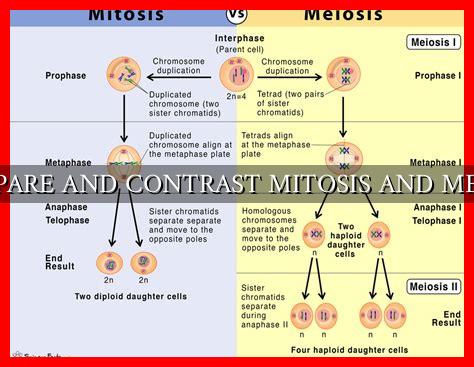
Mitosis is a type of cell division that occurs in somatic cells, leading to the production of two identical daughter cells. It plays a crucial role in growth, tissue repair, and asexual reproduction in organisms. Mitosis consists of four main stages: prophase, metaphase, anaphase, and telophase.
Key Features of Mitosis:
- Produces two identical daughter cells
- Occurs in somatic cells
- Results in diploid cells
- Plays a role in growth and tissue repair
Meiosis
Meiosis is a specialized type of cell division that occurs in germ cells, leading to the production of four genetically diverse daughter cells.
. It is essential for sexual reproduction and ensures genetic diversity in offspring. Meiosis consists of two rounds of division: meiosis I and meiosis II.
Key Features of Meiosis:
- Produces four genetically diverse daughter cells
- Occurs in germ cells
- Results in haploid cells
- Plays a role in sexual reproduction
Comparison of Mitosis and Meiosis
Similarities:
- Both processes involve cell division
- Both processes involve the duplication of DNA
- Both processes involve the separation of chromosomes
Differences:
- Mitosis produces two identical daughter cells, while meiosis produces four genetically diverse daughter cells
- Mitosis occurs in somatic cells, while meiosis occurs in germ cells
- Mitosis results in diploid cells, while meiosis results in haploid cells
- Mitosis plays a role in growth and tissue repair, while meiosis plays a role in sexual reproduction
Examples in Nature
An example of mitosis can be seen in the growth of a plant, where cell division leads to the formation of new tissues and organs. On the other hand, meiosis is essential for the production of gametes in animals, ensuring genetic diversity in offspring.
Conclusion
In conclusion, mitosis and meiosis are two essential processes in the life cycle of organisms, each serving distinct purposes. While mitosis leads to the production of identical daughter cells for growth and tissue repair, meiosis produces genetically diverse daughter cells for sexual reproduction. Understanding the differences between mitosis and meiosis is crucial for comprehending the complexity of cell division and its role in the diversity of life on Earth.
For further reading on the topic, you can explore this article on mitosis and meiosis from Nature.