-
Table of Contents

KCL Problems with Solutions
When it comes to analyzing electrical circuits, Kirchhoff’s Current Law (KCL) is a fundamental principle that plays a crucial role. However, many students and professionals often encounter challenges when applying KCL to complex circuits. In this article, we will explore common KCL problems and provide practical solutions to overcome them.
Understanding KCL
Kirchhoff’s Current Law states that the algebraic sum of currents entering and leaving a node in an electrical circuit must be zero. In other words, the total current flowing into a node must equal the total current flowing out of the node. This principle is essential for analyzing circuit behavior and solving circuit problems.
Common KCL Problems
1. Incorrect Current Direction
One of the most common mistakes when applying KCL is assigning incorrect directions to currents. This can lead to incorrect calculations and solutions. To avoid this problem, always follow a consistent convention for current direction, such as clockwise or counterclockwise, and stick to it throughout the analysis.
2. Missing or Incorrect Nodes
In complex circuits, it is easy to overlook or misidentify nodes, leading to errors in applying KCL. Make sure to properly identify all nodes in the circuit and include them in your analysis. Each node should have a unique label to avoid confusion.
3. Inconsistent Units
Another common issue is using inconsistent units for currents when applying KCL. Ensure that all currents are expressed in the same unit (e.g., amperes) to maintain consistency in calculations. Mixing units can result in incorrect solutions and confusion.
Solutions to KCL Problems
1. Draw a Clear Circuit Diagram
Before applying KCL, draw a clear and organized circuit diagram that clearly shows all components and nodes. A well-labeled diagram will help you visualize the circuit and identify nodes accurately, reducing the chances of errors.
2. Define Current Directions
Establish a consistent convention for current directions in the circuit, such as clockwise or counterclockwise. Stick to this convention when applying KCL to ensure accurate calculations. Label each current with its direction to avoid confusion.
3. Use Node Equations
Write node equations for each node in the circuit based on KCL. Express the sum of currents entering a node as equal to the sum of currents leaving the node. Solve the resulting equations simultaneously to determine unknown currents and voltages.
Example
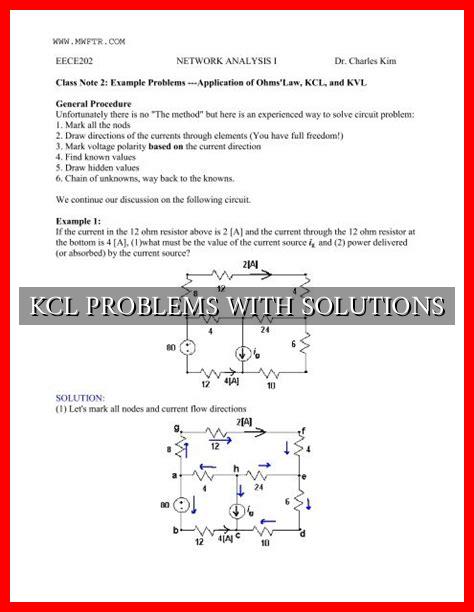
Consider the following circuit with three nodes labeled A, B, and C:

- Node A: (I_1 – I_2 = 0)
- Node B: (I_2 – I_3 = 0)
- Node C: (I_3 + I_4 – I_5 = 0)
Solving these equations simultaneously will help determine the values of the unknown currents in the circuit.
Conclusion
Mastering Kirchhoff’s Current Law is essential for analyzing complex electrical circuits effectively. By understanding common KCL problems and implementing the solutions provided in this article, you can enhance your circuit analysis skills and solve circuit problems with confidence. Remember to draw clear circuit diagrams, define current directions, and use node equations to apply KCL accurately. Practice applying KCL to various circuits to improve your proficiency in circuit analysis.