Table of Contents
6th Grade Compare Ratios
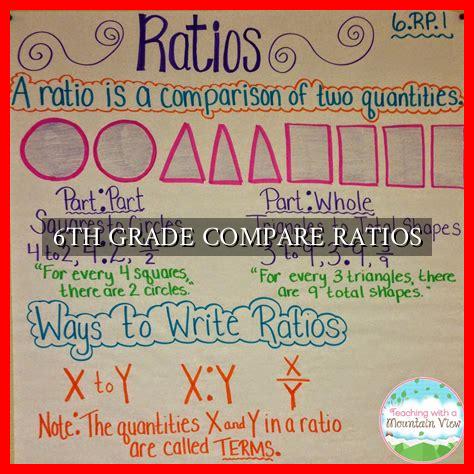
Understanding ratios is an essential skill for students in the 6th grade. Ratios are used to compare quantities and are often expressed as a fraction, such as 2:3 or 5/8. In this article, we will explore the concept of comparing ratios in 6th grade math and provide valuable insights to help students master this important topic.
What is a Ratio?
A ratio is a comparison of two quantities. It is often written as a fraction, with a colon, or using the word “to.” For example, if there are 2 red apples and 3 green apples, the ratio of red apples to green apples is 2:3. Ratios can be used to compare any two quantities, such as lengths, weights, or amounts of money.
Comparing Ratios
When comparing ratios, it is important to ensure that the quantities being compared are in the same units.

. For example, if one ratio is in terms of apples and the other is in terms of oranges, they cannot be directly compared. To compare ratios, you can either convert them to a common unit or scale them up or down to make them equivalent.
Example:
- Ratio 1: 2 red apples to 3 green apples
- Ratio 2: 4 red apples to 6 green apples
In this example, we can see that Ratio 2 is equivalent to Ratio 1, as both ratios represent the same comparison of red apples to green apples. By scaling up Ratio 1 by a factor of 2, we get Ratio 2.
Real-World Applications
Ratios are used in many real-world situations, such as cooking, construction, and finance. For example, in a recipe that calls for 2 cups of flour and 3 cups of sugar, the ratio of flour to sugar is 2:3. Understanding ratios is crucial for following recipes accurately and adjusting ingredient quantities as needed.
Case Study: Baking a Cake
Let’s consider a case study of baking a cake. The recipe calls for 1 cup of flour, 1/2 cup of sugar, and 1/4 cup of butter. The ratio of flour to sugar to butter is 4:2:1. If we want to double the recipe to make two cakes, we would need to double each ingredient quantity to maintain the ratio.
Practice Problems
To reinforce the concept of comparing ratios, students can practice solving problems involving ratios. Here are some sample problems to try:
- Compare the ratios 3:4 and 6:8. Are they equivalent?
- If the ratio of boys to girls in a class is 2:3, and there are 20 boys, how many girls are there?
Summary
In conclusion, understanding how to compare ratios is a fundamental skill for 6th-grade students. By mastering this concept, students can apply ratios to real-world situations and solve a variety of problems. Practice is key to developing proficiency in comparing ratios, so students should engage in regular practice to strengthen their skills.
For more resources and practice problems on comparing ratios, check out this link.